Of course, there are always some hard-headed passengers who simply ignore these instructions, to the irritation of the flight crew and the horror of some passenger who’s afraid that the electronic device will cause the plane to crash (like my ten year old son). During the last campaign, when I was able to ring up my frequent flyer miles due to the daily provincial sorties, I got used to other passengers continuing with their cell phone conversations even while the plane was about to take off and the beeps of incoming messages as they turned on their mobile units as soon as the plane’s wheels touched the ground.
You can’t blame the flight attendants if sometimes their reminder about keeping electronic devices off while in the plane already sounds like a teacher berating a noisy student. After all, it is already an established safety procedure.
 But during our last trip to the United States last month, I was pleasantly surprised that one airline, instead of instructing you to turn off your cell phone and make you feel like you will be in a coffin cut off from the world for the duration of the flight, encourages you to use your wi-fi enabled device and connect to the world (and part with your hard earned money).
 Delta Airlines (are you paying attention, Delta?) has wi-fi enabled flights letting you connect to the internet while flying thousands of feet above the ground. Surfing in the clouds! I was so thrilled with the idea, I became the fool who parted with his $10 just to be able to go online and post a status in my Facebook and Twitter and share with anyone who cared that I was up in the high levels of the earth’s atmosphere while surfing the net.
Although the thought crossed my mind that it was a waste of money, I tried to convince myself that the three hour flight would have been boring if I didn’t purchase a connection.
They were also lenient in their rules, allowing the use of cellphones even while the plane was taxiing to its take off position, and allowing the use again as the aircraft taxied to the terminal after landing.
So, it’s not that dangerous to use cellphones after all. I guess the airlines here in the Philippines just want to be extra careful. One time, on a flight to Cebu, I gently reminded my wife (emphasis on gently) to turn off her cellphone because we were already taxiing to the runway for take off. I told her it was a safety rule.
She did turn off her cell immediately. After which she told me, “if these were really that dangerous, then why don’t the terrorists just ride the plane and turn their cellphones on?”
She was kidding, of course. But it did get me thinking.
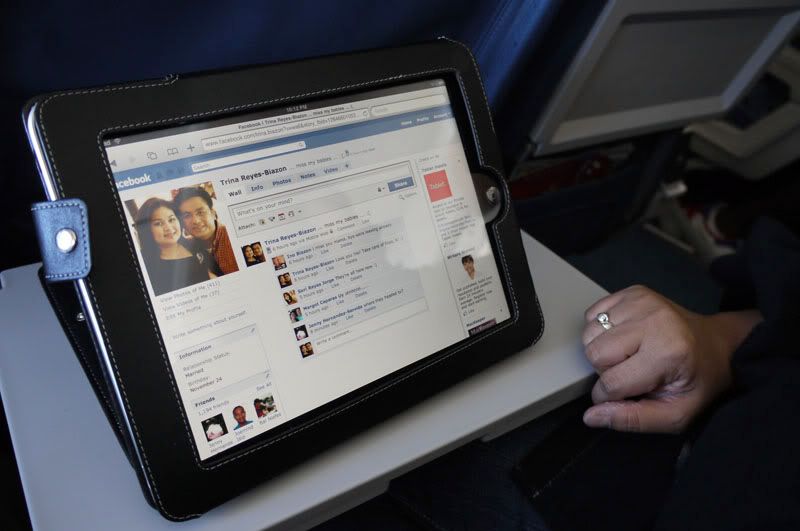 During that mile-high wi-fi experience, I got to surfing about electronic devices on board airplanes. One site said that the Federal Communications Commission of the United States banned the use of cellphones on bard aircraft back in 1991 because there was a suspicion that the signals interfered with aircraft navigation and communications equipment. The Federal Aviation Administration agrees with the FCC and imposed the regulation on commercial aircraft.
Another site tells of an interview with a pilot over ABC News where in the pilot said that the rule for electronic devices to be turned off is meant to ensure that the passengers’ attention are exclusively fixed on the flight crew as they give the safety briefing before the plane takes off. Makes sense, doesn’t it?
Some say that the suspicion that the electronic devices cause harm to the planes equipment has not yet been proven by tests, but it was decided that prudence dictates that it would be better to err on the side of safety. Hence, the ban stays, although various airlines have adopted various rules as to when the cell units should be turned off and when it may be turned on.
As for me, being an avid viewer of Air Crash Investigations in National Geographic Channel, I’d rather not risk my cell phone causing anything that would make the plane I’m riding in get in trouble so I’m obedient when it comes to instructions to turn off electronic devices. And if you’re sitting beside me, you will get a verbal reminder from me if you are not convinced by my accusing glare.
But if I fly Delta, I will happily get my credit card and iPad out and surf in the sky.


